Loading product details...
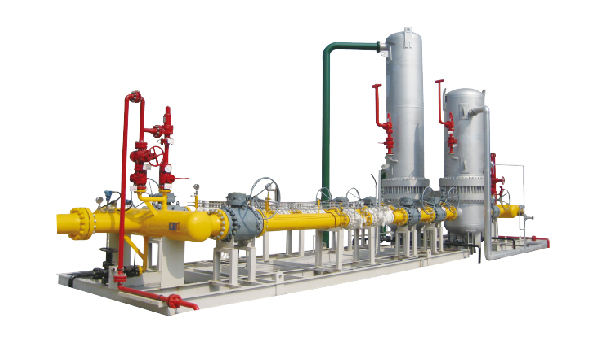
Gas turbine power plants using natural gas as a feedstock require a complete set of natural gas supply system equipment to ensure the efficient and safe operation of the gas turbine. This system typically includes an inlet unit, metering unit, gas pre-treatment unit, pressure regulation (boosting or reducing) unit, temperature regulation (heating or cooling) unit, electrical and control unit, and auxiliary systems such as venting, drainage, and safety monitoring.
The gas turbine power generation supporting natural gas field station equipment of Terrence meets the requirements of the national "Safety Management Regulations for Natural Gas Systems in Gas Power Plants" and complies with relevant international and domestic standards, making it widely applicable for supporting various types of gas power plants.
◆Inlet unit: Usually consists of an insulated joint and an emergency shutdown valve (ESD). The insulated joint serves to isolate potential, and the emergency shutdown valve rapidly cuts off the gas supply in emergency situations to ensure system reliability and safety;
◆Measurement Unit: Consists of an ultrasonic flowmeter, flow computer, pressure and temperature transmitters, and a gas composition analysis system. Under normal circumstances, the gas composition analysis system includes an integrated set of a gas chromatograph, hydrocarbon dew point analyzer, water dew point analyzer, and hydrogen sulfide analyzer. The flow computer receives the flow signals, performs calculations, and enables remote transmission;
◆Gas Pretreatment Unit: Equipped with coarse and fine filtration systems according to the characteristics of different natural gas qualities, in order to remove solid and liquid impurities from the gas. The various filtration systems include options such as cyclones, cyclone filtration separators, and filter separators, and can also be arranged in horizontal or vertical structures based on onsite conditions;
◆Pressure Regulation (Boosting or Reducing) Unit: Regulates the control pressure to meet the gas pressure requirements for gas turbines. Typically, a boosting configuration is suitable when the incoming gas pressure is lower than the required usage pressure, necessitating a natural gas compressor to achieve the boosting purpose; a reducing configuration is suitable when the incoming gas pressure is higher than the required usage pressure, requiring a pressure regulator to reduce the pressure to meet the requirements.
◆ Temperature regulation (heating or cooling) unit: Adjusts the natural gas temperature through various heat exchangers to reach the normal operating range of the gas turbine. Heating is used for the pressure reduction station, while cooling is used for stations with supporting compressor boosting;
◆Electrical and Control Unit: Typically includes a host computer, display screen, PLC, flow computer, as well as a distribution cabinet and UPS, achieving power supply and station control functions;
◆Venting and Drainage System: Venting includes manual and safety vent valves as well as a centralized venting system; drainage consists of drain valves and a wastewater collection system.